The Fragmented Upgrades Problem
Most homeowners approach residential sustainability as a series of disconnected, expensive purchases. They acquire an electric vehicle to escape volatile fuel prices, install solar panels to offset utility bills, or swap to a heat pump to modernize their climate control. However, when these systems operate in isolation, they create an inefficient financial bottleneck. Solar arrays waste excess energy during midday peak production; heat pumps spike electrical consumption during expensive evening hours; and electric vehicles draw high-tariff power from the grid at night.
In the modern economic landscape, achieving true utility independence requires a shift toward an integrated home energy management system design. Instead of managing isolated appliances, homeowners must build a unified, smart microgrid where every asset generates, stores, and cushions the other components.
The Generation Core: Sizing for Residential Solar Panel Payback Period
The foundation of any smart home energy management system design is localized generation. While centralized grid power carries heavy infrastructure markups, residential photovoltaic (PV) arrays offer zero-emission localized production. However, over-indexing or under-indexing your system drastically damages your residential solar panel payback period.
To maximize your return on investment (ROI), system scaling must align with your baseline daytime load rather than your total annual consumption. By understanding local net metering laws and scheduling heavy electrical loads to match peak sunlight hours, you dramatically shorten your break-even timeline.
Step-by-Step ROI Guide: To accurately calculate your installation costs, regional incentives, and break-even timeline, access our complete audit:Are Home Solar Panels Worth It? The Definitive ROI Breakdown.
The Thermal Transition: Heat Pump vs Gas Boiler Efficiency
Once clean generation is established, the next priority is eliminating fossil fuel combustion from the home’s heating and cooling infrastructure. Traditional gas boilers operate on standard thermodynamic limitations, frequently wasting up to 20% of their fuel energy as exhaust heat.
🟢 Modern Heat Pump Systems
- Mechanism: Extracts and amplifies ambient external heat via a closed refrigerant loop.
- Peak Efficiency: 300% to 400% (Yields 3–4 units of heat per 1 unit of electricity).
- Ecosystem Fit: Powered flawlessly by localized solar generation.
🔴 Traditional Gas Boilers
- Mechanism: Relies on the chemical combustion of fossil fuels to generate heat.
- Peak Efficiency: 80% to 95% (Always loses energy through exhaust ventilation).
- Ecosystem Fit: Left completely vulnerable to volatile retail natural gas markets.
When analyzing heat pump vs gas boiler efficiency, modern heat pump systems utilize an advanced refrigerant cycle to move ambient heat rather than creating it. This allows them to achieve operating efficiencies between 300% and 400%. When paired with a smart home panel, space heating and cooling adapt dynamically to your solar output, rendering home climate control virtually free.
Step-by-Step ROI Guide: For a detailed performance analysis, real-world cold-climate data, and 2026 tax credit calculations, see our expert review:Heat Pump vs Gas Boiler: The 10-Year Savings Verdict
Thermal Battery Storage: Smart Eco-Frugal Water Heating Systems
Domestic water heating accounts for approximately 18% of a standard household’s energy footprint. Conventional electric resistance tanks are highly inefficient, drawing constant power to maintain water temperatures 24/7 regardless of actual usage patterns.
Integrating a hybrid heat pump water heater into your home energy management system design introduces a low-cost form of thermal storage. By programming the system to run exclusively during peak solar production windows, you effectively store excess midday electricity as thermal energy. This turns your water tank into a highly effective “hot water battery” at zero marginal cost.
Step-by-Step ROI Guide: Optimize your plumbing infrastructure and cut standby energy loss with our tactical blueprint:Water Heating Systems in 2026: What Actually Costs Less
The Mobility Pivot: EV vs Petrol Cars ROI
Transitioning your household infrastructure away from fossil fuels naturally extends to transportation. Traditional internal combustion engine (ICE) vehicles waste roughly 80% of their fuel energy as ambient heat and friction, turning them into severe financial liabilities over their lifecycle.
When evaluating EV vs petrol cars ROI, electric drivetrains convert over 85% of electrical energy into direct propulsion. When an EV is integrated directly into a solar-equipped home grid, your cost per mile plummets. Instead of paying retail rates at commercial fast-chargers, your daily transportation is powered directly by clean, excess electrons generated right on your roof.
Step-by-Step ROI Guide: Compare long-term maintenance costs, battery degradation statistics, and total fuel savings in our comprehensive data sheet:Electrical vs Petrol Car: The True 5-Year Total Cost of Ownership in 2026.
The Mitigation Layer: Analyzing Home Energy Storage Prices 2026
Solar generation is inherently intermittent—power is captured at noon but heavily consumed at night. To bridge this gap, stationary lithium iron phosphate ($LiFePO_4$) batteries serve as the critical mitigation layer for the household grid.
Current home energy storage prices in 2026 have stabilized, making modular $LiFePO_4$ server rack batteries highly accessible. Incorporating stationary storage prevents you from selling your clean solar energy to utilities for minimal buy-back rates, allowing you to execute “load shedding.” This keeps your home running on stored power during expensive peak hours and maintains total power continuity during grid blackouts.
Step-by-Step ROI Guide: Learn how to size your battery storage capacity without overspending on excess hardware in our guide:Solar Batteries for Home: Is the $10,000 Investment Actually Worth It in 2026?
The Ultimate Synergy: Advanced V2H Solar Design
The most disruptive innovation in modern home energy ecosystems is the integration of mobility and storage through advanced V2H solar design. While dedicated wall batteries are highly effective, their standalone cost per kilowatt-hour remains high.
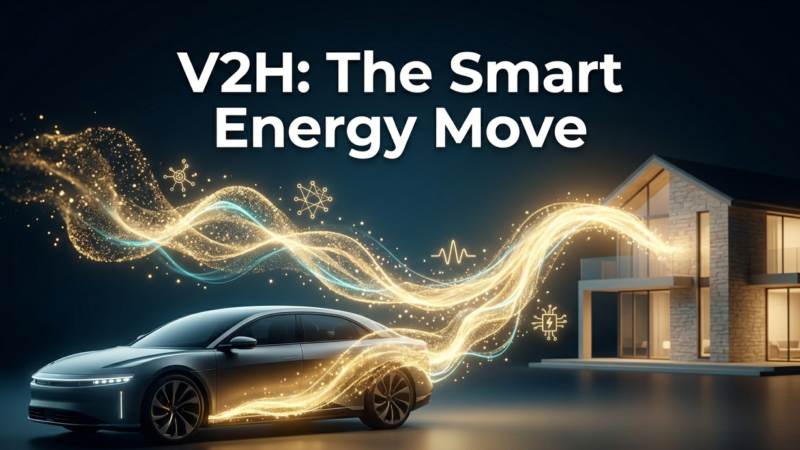
Advanced V2H Energy Loop Logic
Solar arrays produce peak excess power. electrons are routed directly to the garage port.
The electric vehicle absorbs and retains the cheap solar energy in its high-capacity battery matrix.
At 6:00 PM, the grid rate spikes. The bidirectional charger reverses flow to run the home panel entirely for free.
By introducing a bidirectional EV charger, your vehicle transcends its transport function to become a massive energy reserve. With storage capacities often exceeding 80 kWh, your car can power essential home circuits for up to a week during emergencies or discharge power during peak utility pricing hours. V2H design creates a closed financial loop, seamlessly merging your garage and living room into a self-sustaining asset.
Step-by-Step ROI Guide: Discover how to configure bidirectional charging and safely manage your vehicle’s battery health in our implementation plan:The $15,000 Battery in Your Driveway: Why V2H is the Ultimate Frugal Move
The Roadmap to System Integration
Transitioning to a smart, unified home grid does not require an overwhelming, all-at-once financial investment. The most effective strategy relies on a phased, budget-conscious rollout:
- Reduce the Baseline Load: Execute basic DIY weatherization and air sealing for under $50.
- Establish Generation: Install a solar array optimized strictly for your daytime baseline consumption.
- Electrify the Infrastructure: Swap out aging fossil-fuel appliances for high-efficiency heat pumps and water heaters.
- Synthesize Mobility and Storage: Integrate your EV with a bidirectional charging interface to lock in permanent utility independence.
By treating your household as a single, engineered ecosystem, you stop absorbing utility rate hikes and start operating a resilient, self-sustaining financial asset.
Frequently Asked Questions (FAQs)
As of mid-2026, a certified bidirectional EV charger costs between $2,500 and $5,500 for hardware, with installation adding another $1,500 to $3,000 depending on your home panel configuration. However, federal incentives like the 30C tax credit cover 30% of the total cost, significantly accelerating your ROI.
While technically viable through advanced V2H solar design and large battery banks, remaining grid-tied is generally the most eco-frugal choice. Keeping a grid connection allows you to use the utility as a low-cost backup during prolonged bad weather while allowing you to sell extreme generation surpluses back to the grid when rates are favorable.
No, provided you use approved hardware. In 2026, major EV manufacturers explicitly cover V2H operations within their standard battery warranties. Because a typical home power draw is a low, steady discharge (usually 2 kW to 5 kW), it places far less thermal stress on the battery cells than standard highway driving or high-power public DC fast charging.