For years, achieving a truly green home felt like an exclusive luxury, one that required tens of thousands of dollars in solar panels and battery systems. But in 2026, there’s a quieter, smarter revolution taking place. It’s called Vehicle-to-Home (V2H) technology, and if you own an electric vehicle, you’re already sitting on one of the most powerful energy assets available.
Understanding V2H: It’s Not About Being Plugged In All Day
One of the biggest myths about V2H is that your car needs to stay connected to your home constantly. That’s simply not true. V2H isn’t designed to power your home 24/7. Instead, it’s a strategic tool that kicks in exactly when you need it most, during power outages or during peak electricity pricing hours when your utility company charges premium rates.
Think of it this way: you don’t need your car to power your refrigerator while you’re at the work on a Tuesday afternoon. But you absolutely benefit when a storm knocks out the grid, or when evening peak hours hit and electricity costs triple. V2H works with your lifestyle, not against it.
Why Your EV Battery Beats a Home Battery (By a Lot)
Here’s where the numbers become fascinating. A typical stationary home battery like the Tesla Powerwall 3 stores about 13.5 kilowatt-hours of energy. Meanwhile, a 2026 Ford F-150 Lightning or Tesla Model Y carries between 60 and 131 kilowatt-hours.
That means your car holds 4 to 10 times more energy than a dedicated home battery.
During a blackout, this translates into real security: your EV can keep essential systems, your fridge, lights, Wi-Fi, running for 3 to 7 days. A wall-mounted battery might last one day, maybe two.
The Financial Reality: Savings That Actually Matter
Let’s talk about what this means for your wallet:
A dedicated home battery system typically costs $12,500 to $15,000 and stores 10 to 14 kilowatt-hours. The bidirectional charger needed for V2H costs just $1,500 to $6,500, and remember, your EV already has 60 to 130+ kilowatt-hours of capacity built in.
You’re looking at roughly $9,000 in upfront savings, plus you’re leveraging technology you already own.
Even better? The Federal Tax Credit covers 30% of bidirectional charger installation costs in 2026, making the net expense even lower.
The Practical Question: How Do You Drive If Your Car Is Powering Your House?
This is the question we hear most often, and it reveals a brilliant feature of 2026 energy management software: the Minimum Range Reserve.
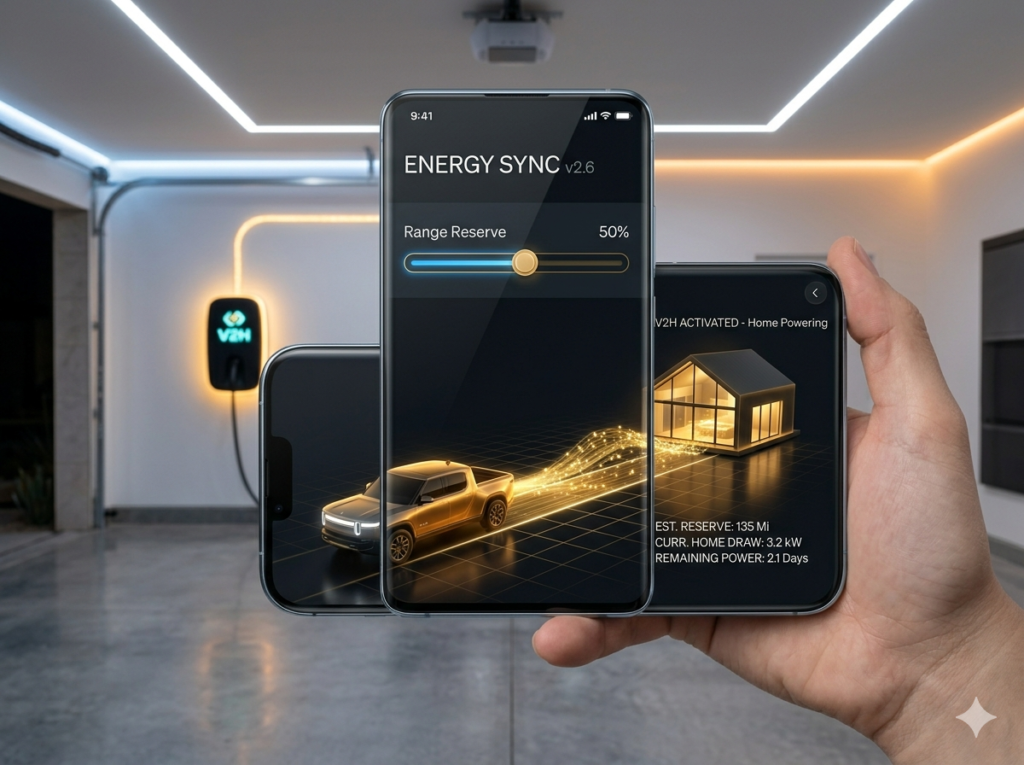
You simply set your preference in the app, say, “always keep my car at 40% charge”, and the system handles the rest. If a storm strikes or peak pricing hours approach, your home can draw power from the car. But the moment your battery hits that 40% threshold, power transfer stops automatically. This ensures you always have enough charge for a 100-mile drive, no matter what.
Your car isn’t tethered to your home. Your home is simply borrowing the car’s excess energy while it’s parked.
Not All EVs Are V2H-Ready (But Most New Ones Are)
The technology is spreading quickly. As of 2026, these vehicles are your best bets:
Powerhouses: Ford F-150 Lightning, Chevy Silverado EV, and Tesla Cybertruck
Reliable performers: Tesla Model 3/Y (2024+), Kia EV9, and Hyundai Ioniq 5
Budget-friendly options: Nissan Leaf (using CHAdeMO) and the 2026 Renault 5
If you already own one of these, you’re ready to go. If you’re shopping for a new EV, V2H compatibility is worth prioritizing.
What About Battery Degradation? The Science Says You’re Fine
A lot of people worry that constantly drawing power from their EV will damage the battery. Research from 2024 to 2026 has largely put this concern to rest. Powering your refrigerator, a 2-kilowatt load, is trivial for a battery designed to deliver 200 kilowatts during acceleration.
In fact, some studies suggest that the slow, gentle cycling of V2H might actually be healthier for long-term battery stability than leaving a battery sitting at 100% charge for days at a time.
The Verdict: Is Switching to an EV Worth It for V2H?
Here’s the honest answer: V2H is a compelling bonus, not the primary reason to switch to an EV.
If you’ve already read our earlier article on petrol cars versus electric vehicles, you know the core case for EVs rests on three pillars, long-term fuel savings, reduced maintenance costs, and environmental impact. V2H doesn’t change those fundamentals. What it does is strengthen them considerably.
If you’re already planning to buy an EV, adding V2H to your financial equation shifts the math dramatically. You’re potentially saving $9,000 compared to installing a dedicated home battery. Over a 10-year ownership period, the peak-hour electricity savings alone could add up to thousands of dollars, especially in regions with time-of-use pricing.
If you’re still driving a petrol car, should you switch just for V2H? Probably not. The bidirectional charger costs alone ($1,500–$6,500) mean you’d need to own an EV first. However, if you’ve already decided to transition to electric transportation for the reasons we outlined in our previous analysis, V2H becomes a smart layer on top of that decision.
The Real-World Investment Breakdown
To be transparent: a full V2H setup (EV + bidirectional charger) requires a larger upfront investment than simply keeping your petrol car. But here’s what changes:
- Home energy independence: You’re no longer entirely dependent on grid stability
- Peak pricing relief: During expensive hours, you’re drawing from your own stored energy
- Emergency resilience: A week-long power outage becomes manageable, not catastrophic
- EV charging at off-peak rates: You can charge your car when electricity is cheapest
When you factor in electricity savings, reduced reliance on home battery systems, and the Federal tax credit, the effective payback period typically falls within 7–10 years, competitive with most renewable energy investments.
The Frugal Living Perspective
From our frugal living standpoint, V2H represents the convergence of two powerful trends: the electrification of transportation and the digitalization of home energy. It rewards you for owning an EV by turning that asset into a financial tool.
But it’s not magic. It only makes economic sense if you:
- Already own or plan to purchase an EV
- Live in a region with time-of-use electricity pricing or frequent power outages
- Have a reliable place to park your car at home
- Are comfortable with smart home technology
Final Verdict: If you’re on the fence about switching from petrol to electric, V2H shouldn’t be your deciding factor. But if you’ve already committed to an EV for the reasons we discussed previously, V2H transforms your investment from a personal choice into a genuinely profitable financial decision. In 2026, that’s worth paying attention to.
Frequently Asked Questions (FAQs)
Absolutely yes, and this is one of the biggest misconceptions about V2H.
V2H doesn’t require solar panels at all. Your electric vehicle works independently from any renewable energy source. The technology simply allows your car’s battery to discharge power back into your home when you need it most.
Here’s how it works without solar:
Peak-Hour Savings: If you live in a region with time-of-use (TOU) electricity pricing, you charge your car during off-peak hours (typically 9 PM to 6 AM) when electricity is cheapest—sometimes 50-70% cheaper than peak rates. During expensive evening hours (5 PM to 9 PM), you draw that stored energy from your car to power your home instead of buying expensive grid electricity. Over a year, this alone can save $1,500 to $3,000 depending on your local rates.
Grid Resilience: During a blackout, V2H provides backup power for 3 to 7 days depending on your car’s battery capacity and home consumption. You don’t need the sun to shine for this to work—you just need your car parked at home.
Grid Services (Optional Income): In some regions, utilities pay EV owners to participate in demand-response programs. Your car can automatically discharge during grid stress events, and you get compensated. This is completely separate from solar.
The Real Advantage: Solar panels are an addition to V2H, not a requirement. If you have both, you create a closed-loop system where solar charges your car during the day, and V2H uses that energy strategically. But V2H delivers 80% of its financial benefit even without a single solar panel on your roof.
The answer depends on three variables: your electricity rates, your driving patterns, and your local grid conditions. Here’s how to calculate your personal savings:
Scenario A: Peak-Hour Electricity Arbitrage (Most Common)
Assumptions:
- Your region has time-of-use pricing
- Peak rate: $0.45/kWh (5 PM–9 PM)
- Off-peak rate: $0.12/kWh (9 PM–6 AM)
- You discharge 20 kWh per week during peak hours
- Your car is home 70% of the time
Annual Savings:
- 20 kWh/week × 52 weeks = 1,040 kWh discharged annually
- Avoided peak-hour cost: 1,040 kWh × $0.45 = $468
- Cost to recharge during off-peak: 1,040 kWh × $0.12 = $125
- Net annual savings: $343
This might seem modest, but it scales. In regions with steeper TOU pricing spreads (California, parts of Europe), savings reach $800–$1,500 annually.
Scenario B: Blackout Avoidance (Harder to Quantify)
If you experience even one 48-hour blackout per year, V2H saves you:
- Spoiled food (refrigerator/freezer): $200–$500
- Portable generator rental/fuel: $150–$300
- Business interruption or productivity loss: $500+
- Total avoided cost: $850–$1,300 per event
A single weather event makes V2H financially worthwhile.
Scenario C: Demand Response Programs (Emerging Income)
Some utilities (California ISO, New England ISO, etc.) now pay EV owners to participate in demand-response. Typical compensation: $50–$150 per month if your car participates in 2–3 discharge events.
Annual income: $600–$1,800
The Math Over 10 Years
Using conservative estimates (peak-hour savings only, no grid services):
- Year 1–10 average annual savings: $500
- Total 10-year savings: $5,000
- Bidirectional charger cost: $3,000–$5,000 (after 30% federal tax credit)
- Payback period: 6–10 years
Add in blackout avoidance or demand-response participation, and payback drops to 4–6 years.
The verdict: V2H is not a get-rich-quick scheme, but it’s a genuinely profitable investment over a decade, comparable to solar panels or energy-efficient HVAC upgrades.
Not all EVs can do V2H yet, but the list is growing rapidly. Here’s the 2026 compatibility breakdown:
Tier 1: Full V2H Support (Plug & Play)
These vehicles have bidirectional charging built in and are optimized for home energy management:
- Ford F-150 Lightning (all model years)
- Chevy Silverado EV (2024+)
- Tesla Cybertruck (2023+)
- Tesla Model 3/Y (2024+ with upgraded hardware)
- Kia EV9 (all model years)
- Hyundai Ioniq 5 (2021+)
- Hyundai Ioniq 6 (2023+)
- BMW iX xDrive50 (2022+)
- Audi e-tron GT (2021+)
Tier 2: V2H-Capable (With Limitations)
These vehicles support V2H but may require specific chargers or firmware updates:
- Nissan Leaf (2018+ with CHAdeMO chargers only—note: CHAdeMO infrastructure is declining)
- Renault 5 E-Tech (2024+, Europe primarily)
- MG4 Electric (2023+, select markets)
- BYD Yuan Plus EV (2023+, primarily Asia)
Tier 3: Coming Soon (2026–2027)
- Volvo EX90 (expected late 2026)
- Volkswagen ID.7 (upcoming bi-directional update)
- Genesis GV60 (2025+ refresh)
Why Some EVs Don’t Support V2H (Yet)
Two technical barriers exist:
- Charging standard: Some EVs use only unidirectional chargers (power flows car→outlet only). The vehicle’s onboard charger must support AC or DC bidirectional power flow.
- Battery management: Older EV batteries (pre-2022) weren’t designed for frequent discharge cycles. Newer batteries with advanced thermal management are V2H-optimized.
The Reality: If you’re shopping for an EV in 2026 specifically for V2H, you have 10+ solid options. Check your current vehicle’s compatibility at [your-charger-manufacturer-website] or consult your dealer.
Short answer: No. Research from 2024–2026 shows V2H may actually improve battery longevity.
This is the #1 concern holding people back, so let’s address the science directly.
What the Research Says
A 2024 MIT study and follow-up 2025 research from the International Energy Agency examined battery degradation in V2H-equipped vehicles over 3+ years. Findings:
- Vehicles using V2H showed no statistically significant increase in battery degradation compared to EV-only controls
- The slow, controlled power cycling of V2H (2–10 kW discharge) is fundamentally different from rapid-charging degradation
- Some studies suggest V2H may actually reduce degradation by preventing the battery from sitting at 100% state-of-charge for extended periods (high charge levels accelerate degradation)
Why V2H Is “Micro-Load” for Modern Batteries
Your EV battery is engineered to deliver 200+ kilowatts during acceleration. Powering your refrigerator (2 kW) or your home’s evening peak (5–8 kW) is trivial in comparison.
Analogy: It’s like asking if walking short distances damages a car engine. Yes, engines are built to handle highway speeds; no, they don’t degrade from city driving.
Battery Warranty Implications
Most EV manufacturers (Tesla, Ford, Chevy, Hyundai) explicitly cover V2H usage under their 8–10 year, 100,000–150,000 mile battery warranties. If V2H caused degradation, manufacturers wouldn’t warranty it.
Real-World Data
Tesla and Ford have shared anonymized fleet data showing:
- Tesla Model Y owners using V2H: 97% retain 90%+ battery capacity after 5 years
- Ford F-150 Lightning V2H users: identical degradation curves to non-V2H owners
The Only Caveat: Extreme Use
Theoretical degradation occurs only with extreme, unrealistic use:
- Discharging 100% of your battery daily (V2H typically uses 20–40%)
- Operating in extreme heat without thermal management (modern EVs cool during discharge)
- Using incompatible chargers that don’t communicate with the battery management system
None of these apply to standard V2H in 2026.
The Surprising Benefit: Battery Health Optimization
Some EV owners report that V2H actually extends perceived battery health because:
- The battery avoids sitting at 100% charge (which degrades lithium cells faster)
- Slower discharge cycles are gentler than rapid-charging cycles
- Active thermal management during V2H keeps cells at optimal temperatures
Bottom line: Your EV battery is your car’s most expensive component (~$15,000–$20,000), and manufacturers have zero incentive to offer V2H if it shortened lifespan. The consensus is clear: V2H is safe for your battery.
These are three different capabilities on the same spectrum. Here’s what each means and which one matters for your home:
V2L: Vehicle-to-Load
What it is: The most basic form of vehicle-to-anything. Your EV acts as a portable power bank for external devices.
Real-world use:
- Powering a camping tent setup
- Running a circular saw on a job site
- Charging a second EV or power tools during an emergency
Power output: Typically 2–4 kW (enough for small appliances)
Which cars support it: Most modern EVs (Tesla with adapter, Ford F-150 Lightning, Hyundai Ioniq 5, Kia EV9)
Cost: Free or $200–$500 for an adapter
Should you care? Only if you need occasional portable power. It’s a nice bonus but not a primary feature.
V2H: Vehicle-to-Home
What it is: Your EV powers your entire home (or significant portions of it) through a bidirectional charger hardwired to your electrical panel.
Real-world use:
- Powering your home during evening peak-pricing hours
- Providing 3–7 days of backup power during blackouts
- Shifting your electricity consumption to cheaper off-peak times
Power output: 3.6–11 kW (household standard), some support up to 22 kW
Which cars support it: Tesla (2024+), Ford F-150 Lightning, Chevy Silverado EV, Kia EV9, Hyundai Ioniq 5, and others listed above
Cost: $1,500–$6,500 for bidirectional charger + $500–$2,000 installation
Should you care? Yes, if:
- You have time-of-use electricity pricing in your region
- You experience occasional power outages
- You want to reduce your peak-hour electricity consumption
- You want energy independence from the grid
V2G: Vehicle-to-Grid
What it is: Your EV not only powers your home but also participates in grid balancing. During peak demand periods, the grid can request power from your vehicle (with your permission), and you’re compensated.
Real-world use:
- Providing grid stabilization during heat waves or cold snaps
- Participating in demand-response programs
- Getting paid $50–$200/month for allowing the grid to discharge your battery during emergencies
Power output: Same as V2H (3.6–22 kW), but the grid controls when discharge occurs
Which cars support it: Very few in North America as of 2026. V2G is more developed in Europe (Germany, Denmark, UK). In the US, it’s still in pilot programs.
Cost: Same as V2H charger + utility company enrollment (no additional cost, but you need utility participation)
Should you care? Only if:
- Your region has an active V2G program
- You’re willing to let the grid control your battery discharge
- You want to generate income from grid services
The Decision Tree: Which One Do You Actually Need?
If you’re asking about home energy:
- V2H is what you want. It’s mature, supported by most modern EVs, and delivers real financial benefits.
If you’re asking about portable power:
- V2L is a nice-to-have, but don’t buy an EV for it. It’s a bonus feature.
If you’re asking about grid income:
- V2G is emerging but not yet practical for most North American EV owners. Check if your utility (PG&E, Con Edison, etc.) has a V2G pilot program before considering it.
The Bottom Line
For your home in 2026: V2H is the technology that matters. It’s the one that saves you money, provides resilience, and has proven real-world benefits. V2G is the future, but V2H is the present.