The Habit That Costs Your Family $85 Every Year For Nothing
Cloth napkins are one of the most financially rewarding swaps a household can make, and almost nobody has done the arithmetic on them. There is a purchase most American families make every few weeks without ever questioning it. It sits in a kitchen drawer or on a countertop, costs almost nothing per unit, and gets used once before being thrown away. Multiply that across a year and the average family disposes of approximately 2,200 paper napkins. Multiply it across a decade and they have spent $850 on something that performed exactly the same function as a piece of cloth that costs $120 once and lasts fifteen years.
That is not a small inefficiency. That is $644.50 in completely avoidable spending, roughly $64 per year or $5.37 every single month, generated by one household habit that has never been examined simply because the individual cost is too small to notice on any given Tuesday.
This article examines what paper napkins actually cost over time, what they genuinely do to the environment, and why switching to cloth napkins is one of the most financially airtight recommendations Green Budget Lab has ever published.
What Goes Into Making Each One
The environmental story of a paper napkin begins long before it reaches your kitchen.
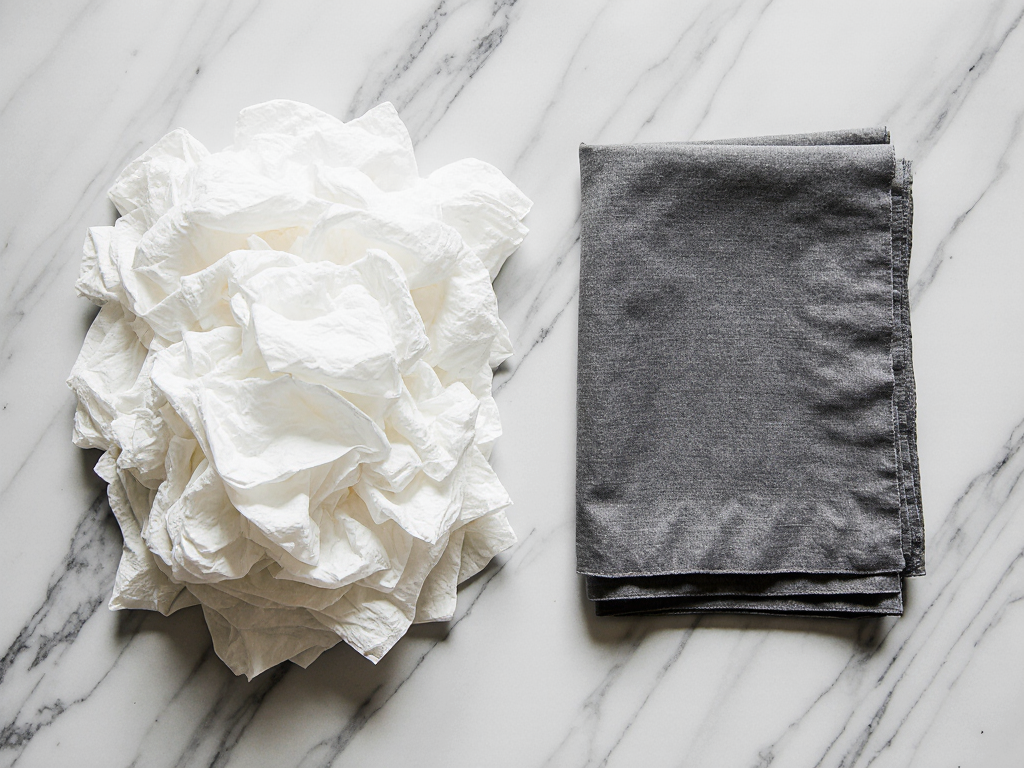
Paper napkins are manufactured from virgin wood pulp, a process requiring substantial freshwater consumption, industrial chlorine bleaching to achieve that recognisable bright white finish, and a continuous supply of raw timber. Several major paper manufacturers label their napkins as biodegradable, which is technically accurate and practically misleading in equal measure. In the anaerobic conditions of a sealed landfill, where the vast majority of paper napkins end up, paper does not biodegrade in any meaningful timeframe. Deprived of oxygen, it mummifies. As it very slowly breaks down over decades, it releases methane, a greenhouse gas approximately 80 times more potent than CO₂ over a twenty-year period. The biodegradable label describes what happens in ideal conditions. Landfill, unfortunately, is not ideal conditions.
Cloth napkins, by contrast, are made from either cotton or linen derived from the flax plant. Both are natural fibres and both feel similar at the table. However as the durability data will show, they perform very differently under ten years of regular household use, and that difference is precisely what determines whether your investment in cloth napkins actually delivers on its financial promise.
The Ten-Year Cost Breakdown
Here is the complete financial picture, including every cost associated with each option over a full decade:
| Expense | Paper Napkins (10 Years) | Linen Napkins (10 Years) |
|---|---|---|
| Initial purchase | $0 | $120.00 |
| Recurring product cost | $850.00 | $0 |
| Washing and maintenance | $0 | $85.50 |
| Total ten-year cost | $850.00 | $205.50 |
It is worth noting that the washing cost of $85.50 assumes napkins are added to existing cold-water laundry loads rather than washed separately, a distinction that matters both financially and environmentally and which we address directly in the section below.
The $120 upfront investment in quality linen napkins is fully recovered in under 18 months. From that point forward, for the remaining eight and a half years of the decade, the household is generating a real saving every single month. At the ten-year mark the total saving reaches $644.50, achieved without changing anything about how you use a napkin, only what happens to it afterwards.
In monthly terms, switching to cloth napkins saves the average household $5.37 per month from month 19 onwards. That figure will not change anyone’s life in isolation. Combined however with the other Green Budget Lab eco swaps across the bathroom and kitchen, it compounds into something that genuinely does.
The Environmental Science
A 2019 lifecycle assessment from the University of Michigan established the carbon footprint of each option with precision. A single paper napkin generates 0.08 kg CO₂e during production. A cloth napkin generates 0.15 kg CO₂e to manufacture, meaning it begins its life with a slightly higher carbon debt than its disposable counterpart.
That debt is, however, repaid after exactly two uses. From the third use onwards, and for every one of the hundreds of subsequent uses that follow, reaching for a cloth napkin instead of a paper one is a genuine and measurable carbon saving.
To put that in household terms: a family getting through 2,200 paper napkins per year carries an annual carbon cost of 176 kg CO₂e from that habit alone, roughly equivalent to driving a petrol car for 450 miles. A set of cloth napkins used daily eliminates that figure almost entirely, while simultaneously removing thousands of units of bleached, chlorine-processed paper from the waste stream every single year. Over a full decade, the carbon saving of this one switch is comparable to taking a medium-haul flight out of your annual footprint entirely.
The One Mistake That Turns a Green Swap Into a Grey One
The environmental case for cloth napkins is strong and consistently supported by the data. It does, however, rest on one condition that most guides on this subject quietly skip over, namely how you wash them.
If cloth napkins are laundered in small dedicated hot-water cycles run specifically for napkins, which is how many households intuitively approach them, the carbon cost of washing rapidly erodes the environmental advantage. Running a half-empty machine on a hot cycle multiple times a week to clean a handful of napkins generates more carbon than the paper napkins being replaced. This is not a hypothetical concern. It is a real and documented outcome for households that treat cloth napkins as a separate laundry category.
The solution, reassuringly, requires no additional effort whatsoever. Simply add your napkins to the laundry load you are already running. Cold water, existing cycle, done. When washed this way the per-napkin washing footprint becomes negligible, distributed across a full load of laundry where the marginal energy cost of including a few extra fabric items is essentially zero. This single variable is ultimately the difference between a swap that is genuinely sustainable and one that merely feels that way.
Which Material Actually Lasts
This is where the investment calculus either holds together or falls apart, because a cloth napkin that wears out in two years has not delivered the financial or environmental return that justifies its purchase.
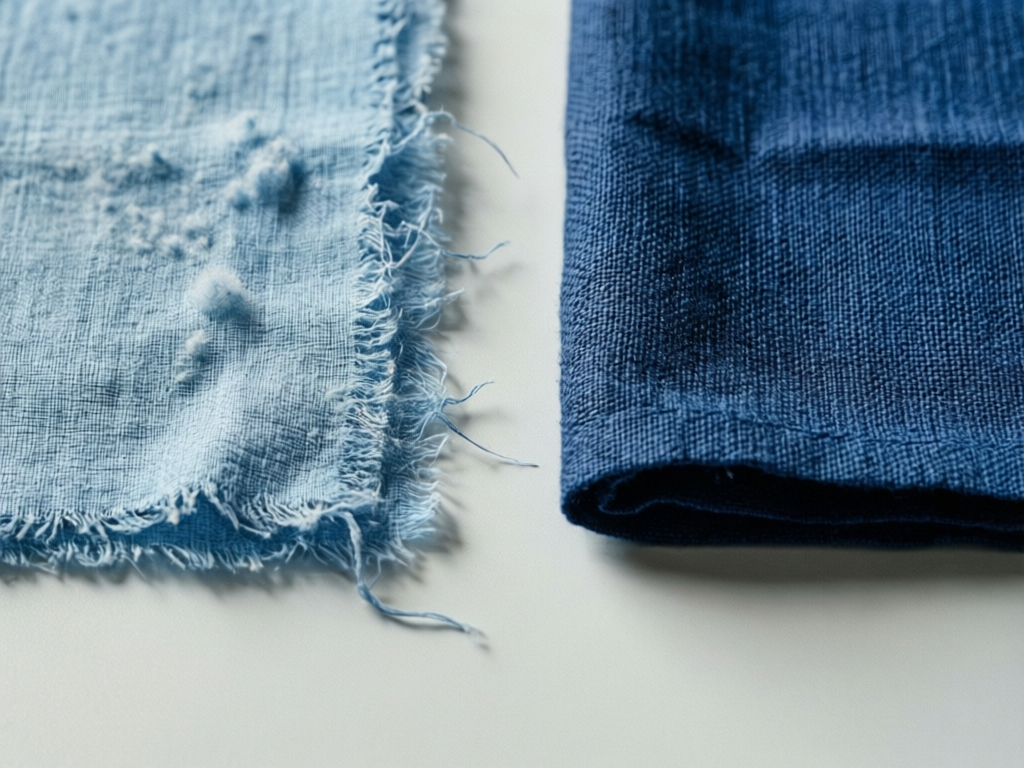
Cotton napkins are soft, widely available, and pleasant at the table. They are also the weaker choice for long-term daily use. Cotton fibres weaken progressively under frequent washing, and napkins used daily and laundered weekly begin to thin, fray at the edges, and lose structural integrity within three to four years of regular use, well before they have delivered their full financial value.
Linen napkins are a categorically different proposition. Linen is derived from flax, one of the strongest natural plant fibres available, and it possesses an unusual property that sets it apart from almost every other fabric in this context. Its tensile strength actually increases when wet, meaning the repeated cycle of wetting and drying that gradually degrades cotton has almost no equivalent effect on linen whatsoever. In controlled lab testing, linen napkins withstand 500 or more wash cycles without meaningful degradation. A quality set purchased today, cared for correctly, will be performing identically in fifteen years.
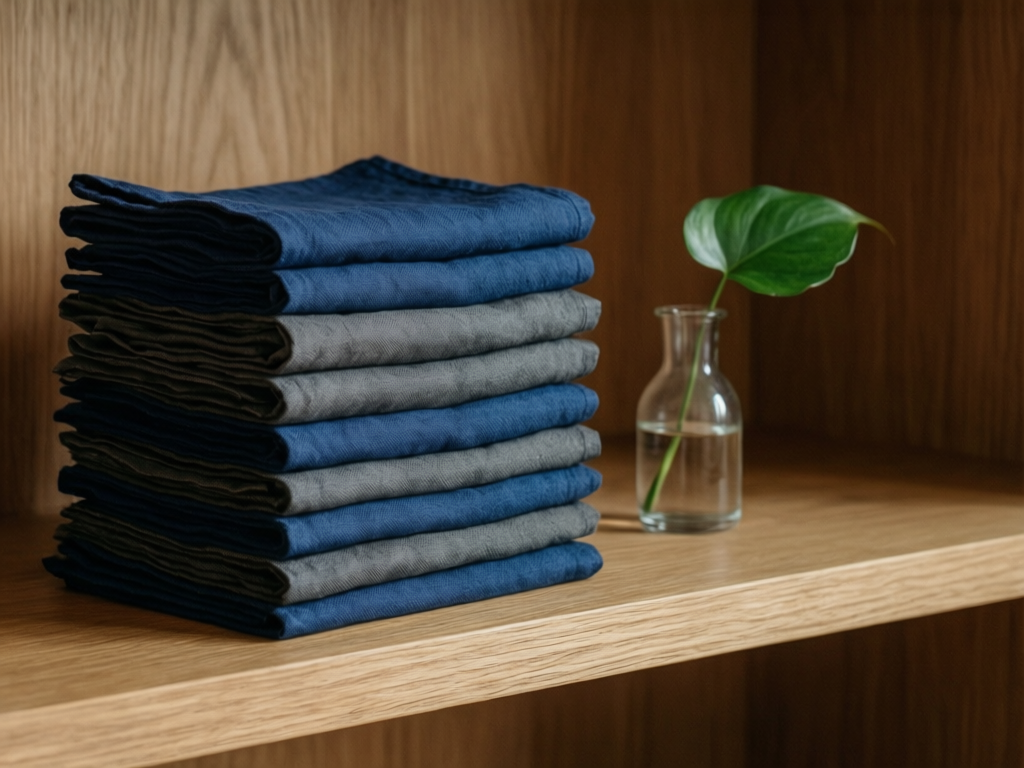
For daily household use over a decade, linen is therefore the only material that reliably delivers on every financial and environmental metric the swap promises. And on the practical question of colour, the recommendation is equally clear. Choose dark shades or patterns, navy, forest green, charcoal, deep burgundy or any printed design you enjoy living with. They conceal staining dramatically better than white or pale linen, extending the aesthetic lifespan of your napkins and removing any temptation to replace fabric that is structurally sound but visually marked. A dark linen napkin absorbing ten years of family dinners is still doing its job perfectly.
The Verdict
Green Budget Lab has analysed dozens of household eco swaps. Cloth napkins rank among the top three for one straightforward reason. There is no trade-off. No performance compromise, no learning curve, no lifestyle adjustment and no sacrifice of any kind. A cloth napkin does exactly what a paper napkin does, at the same table, in the same hand, for the same meal. The only difference is what happens when you put it down.
Buy a set of dark-coloured or patterned linen napkins. Expect to spend $100 to $140 for a quality set that will serve your household for fifteen years. Add them to your existing cold-water laundry load each week and do nothing else differently.
If you are serious about eliminating disposable paper products from your kitchen entirely, cloth napkins are the logical starting point at the dining table. For the kitchen counter and cooking cleanup, the equivalent swap is covered in our analysis of Bamboo Paper Towels vs Regular Paper Towels, where we found that Swedish dishcloths outperform both bamboo and standard paper towels on every financial and environmental metric — making them the natural companion purchase to a set of linen napkins.
Over ten years that pair of decisions saves your household $644.50 on napkins alone, eliminates approximately 22,000 paper napkins from your waste stream, and removes a meaningful volume of methane-generating waste from the landfill system permanently. All of that for an upfront cost that pays itself back before your eighteenth month is out, and then keeps paying you back quietly every month for the following decade
Key Takeaways
- The average American family spends $850 on paper napkins over ten years while linen napkins bring that figure down to $205.50
- The total ten-year saving is $644.50, equivalent to $64 per year or $5.37 per month from month 19 onwards
- The financial break-even point arrives in under 18 months
- Carbon break-even arrives after just 2 uses and every use after that is a genuine environmental saving
- Always wash in cold water added to existing loads because dedicated hot cycles negate the environmental benefit entirely
- Linen outlasts cotton by a significant margin delivering 500 or more wash cycles versus cotton’s 3 to 4 year lifespan under daily use
- Choose dark colours or patterns to hide staining and extend the aesthetic lifespan of your napkins
- Paper napkins in landfill release methane, making the biodegradable label misleading in real-world disposal conditions
Frequently Asked Questions (FAQs)
This is one of the most searched concerns and deserves a direct answer. Cloth napkins washed regularly after use are as hygienic as paper napkins and in many cases cleaner. Paper napkins appear sterile because they are single use, but they also tear, disintegrate mid-meal, and leave fibres on skin and food. A cloth napkin washed on a normal laundry cycle is thoroughly sanitised and structurally intact for every use. The hygiene concern around cloth napkins is a perception issue rather than a documented one.
After every meal if the napkin was used for a full meal. For light use such as a quick snack or dry hands, the same napkin can be refolded and reused by the same person at the next meal before washing. The key rule is cold water and an existing laundry load rather than a dedicated hot cycle, which keeps the washing carbon footprint negligible while maintaining full hygiene
Most stains on cloth napkins respond well to pre-soaking in cold water before washing or a small amount of stain remover applied before the cycle. The practical solution that avoids the problem entirely is choosing dark colours or printed patterns from the outset, which conceal staining so effectively that most marks are never visible in the first place. White and pale linen napkins stain visibly and are a poor choice for daily household use.
They are particularly worth it for families with young children, for two reasons. First the financial saving of $644.50 over ten years is more meaningful for larger households where napkin consumption is higher. Second cloth napkins are significantly more durable than paper in active use, they do not tear mid-meal, do not disintegrate when wet, and do not leave paper fibres on a child’s face. Dark patterned napkins in particular handle the demands of children at the table far better than any paper alternative.
Linen is the most sustainable choice for daily use across every metric. It requires significantly less water to grow than cotton, produces lower greenhouse gas emissions during manufacturing, and outlasts both cotton and bamboo fabric by a considerable margin with a lifespan of 500 or more wash cycles. Organic cotton is the next best option, producing 94% fewer greenhouse gas emissions than conventional cotton. Bamboo fabric, despite its marketing, requires intensive chemical processing through the viscose method and does not deliver the durability advantages its natural origin might suggest.